Eduqas · GCSE · English Language
Section B (30%) – Writing
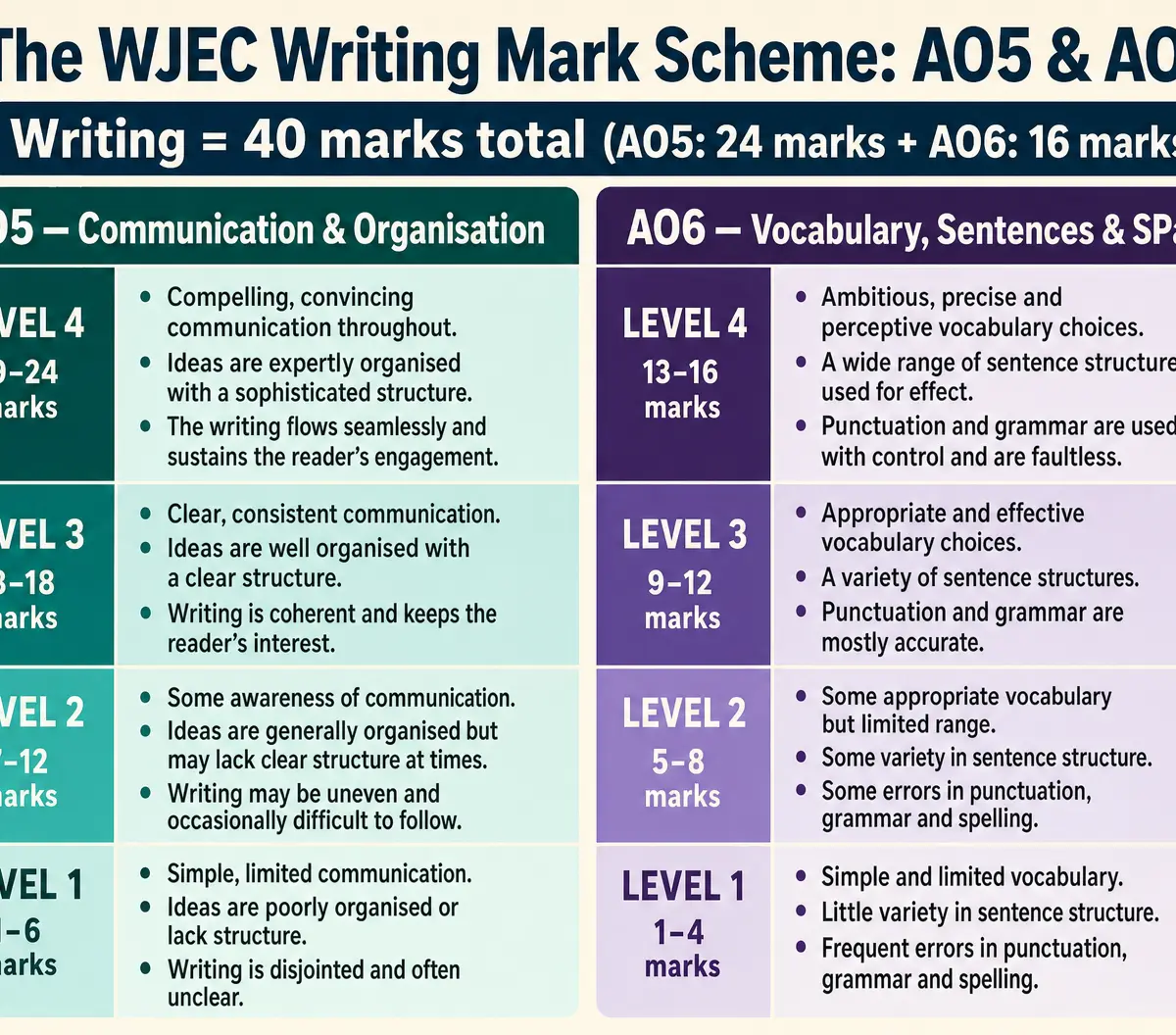
Section B Writing tests your ability to communicate effectively and imaginatively (AO5) while demonstrating technical accuracy (AO6). This section accounts for 40% of your component mark, requiring you to adapt your tone, style, and register for specific forms, purposes, and audiences.
- 4 min read
- 2 worked examples
- 5 practice questions
- 8 key terms
Study Notes
Overview
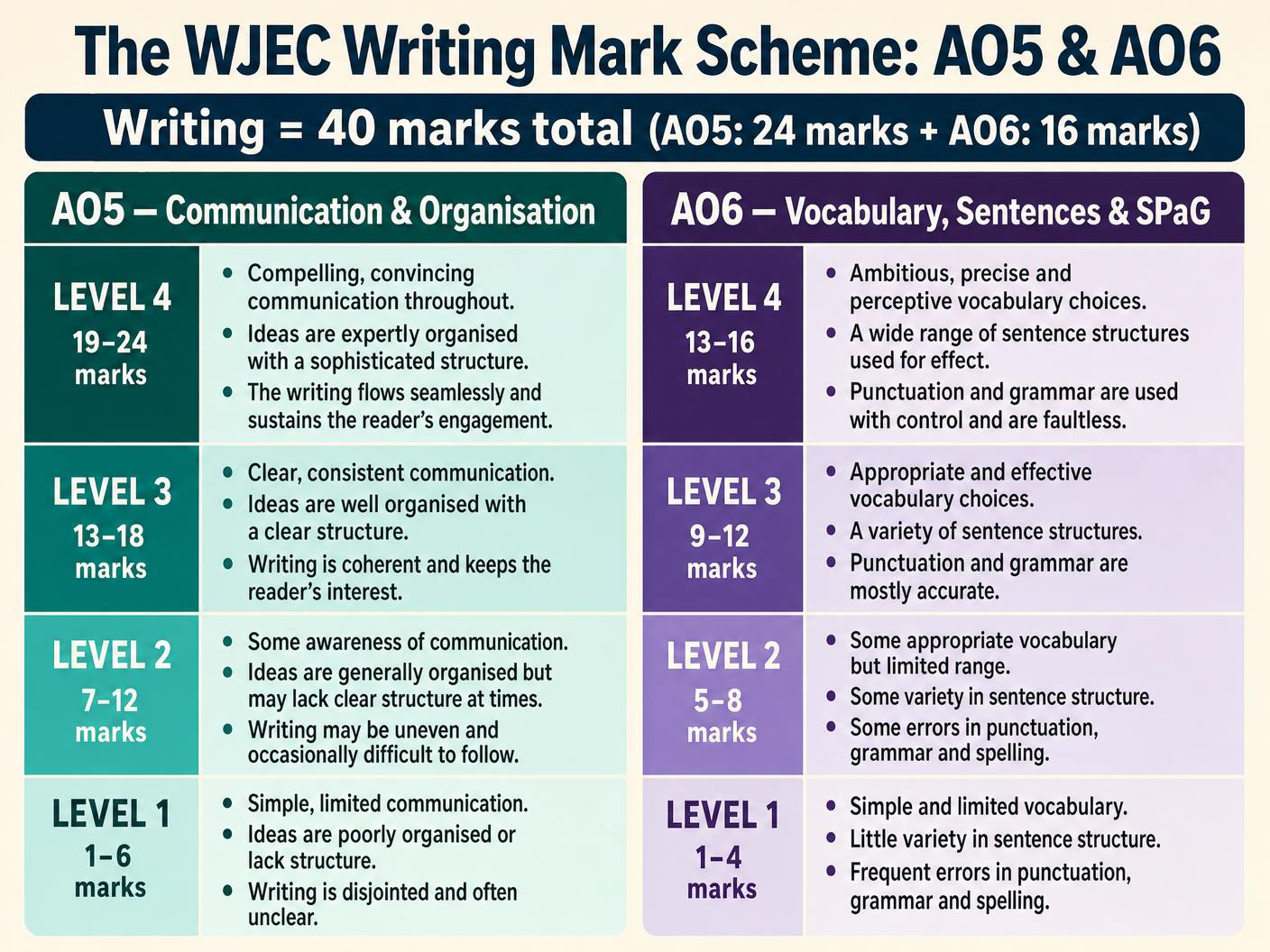
Section B of the WJEC Eduqas GCSE English Language exam assesses your writing skills. It is worth 40 marks in total (40% of the component). You will face either a creative writing task (Component 1) or transactional writing tasks (Component 2). The marks are split across two Assessment Objectives:
- AO5 (24 marks): Communication and organisation (ideas, structure, tone, style, register).
- AO6 (16 marks): Vocabulary, sentence structures, spelling, and punctuation.
Listen to our comprehensive podcast guide to master this section:
Creative Writing (Component 1)
In Component 1, you will be asked to write a narrative, a description, or a personal recount. Examiners reward writing that is "compelling and convincing" (Level 4).
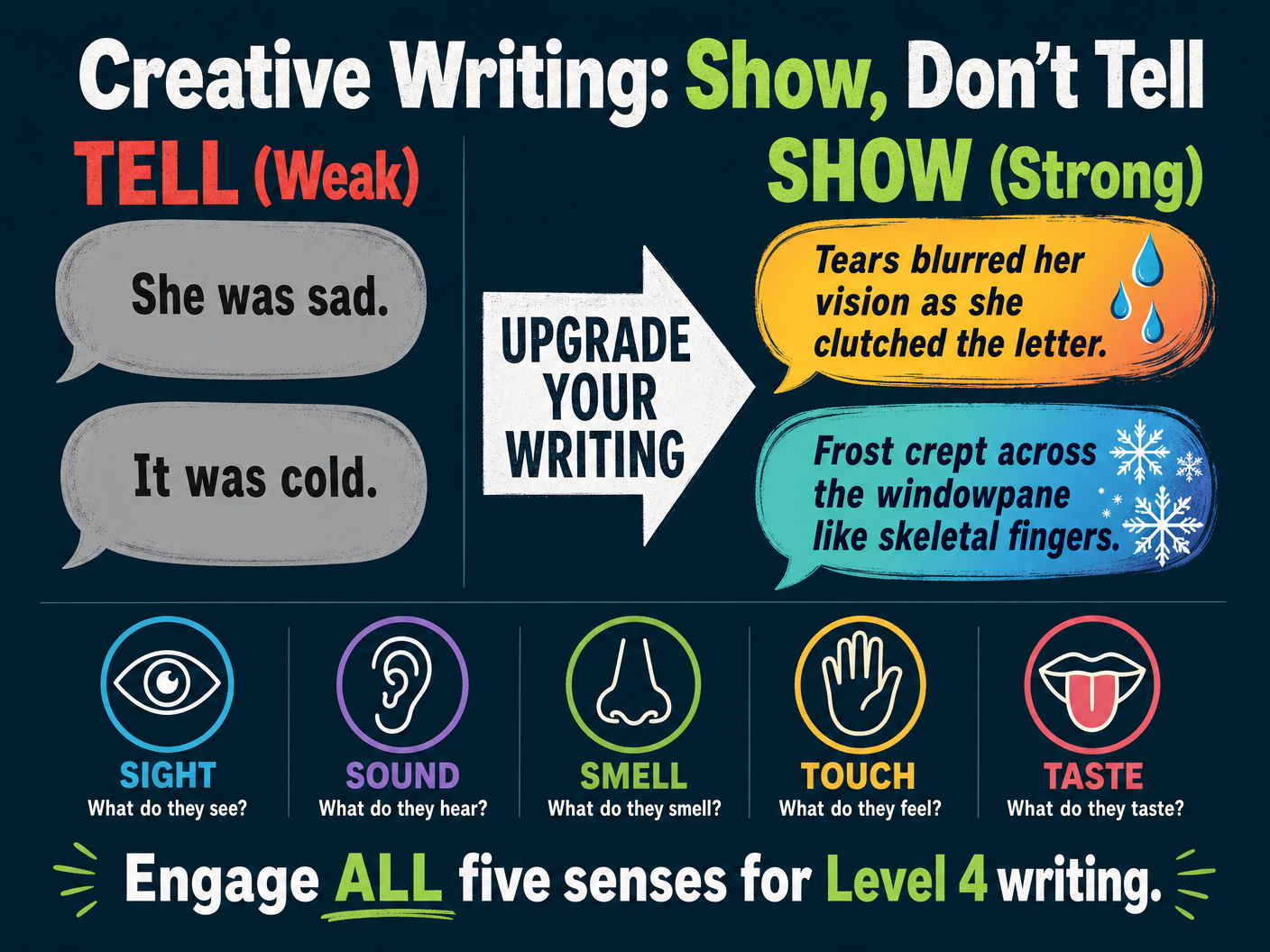
The Golden Rule: Show, Don't Tell
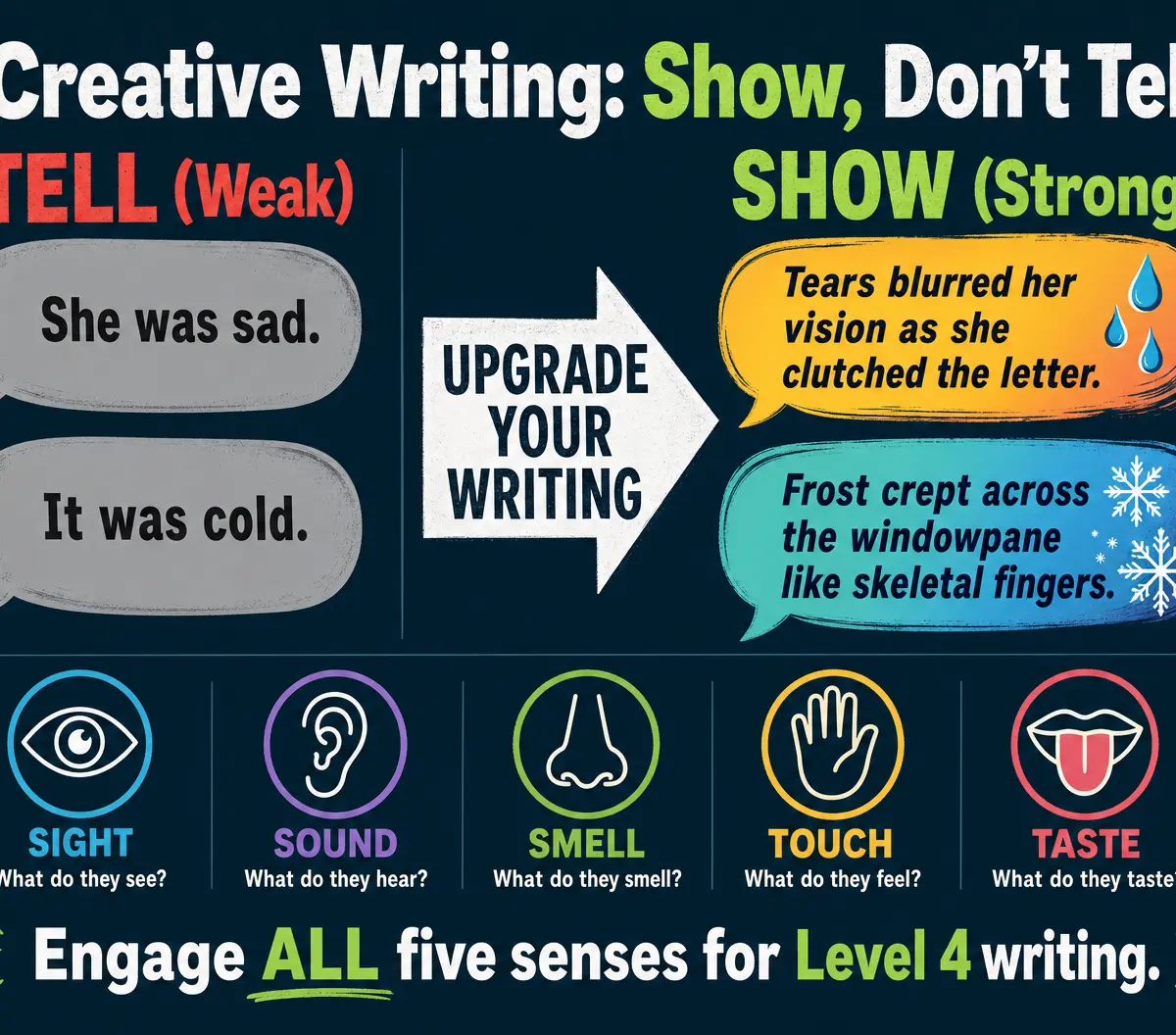
Instead of simply stating a fact or an emotion (telling), use sensory details and actions to allow the reader to infer it (showing).
- Tell: He was terrified.
- Show: His hands trembled so violently he dropped the key, the metallic clatter echoing in the silent hallway.
Narrative Structure
Structure is critical for AO5 marks.
- Openings: Hook the reader immediately. Use in medias res (starting in the middle of the action) or a striking sensory description.
- Development: Build tension or atmosphere gradually. Do not rush the plot.
- Endings: Aim for a satisfying resolution or a deliberate cliffhanger. A circular structure, where the ending echoes the opening, shows sophisticated craft.
Transactional Writing (Component 2)
Component 2 requires you to write for a specific purpose, audience, and form (PAF). This could be an article, a formal letter, a speech, a review, or a leaflet.
The PAF Framework
Before writing, you must identify:
- Purpose: Why are you writing? (To persuade, advise, inform, review?)
- Audience: Who will read this? (Peers, adults, headteacher, general public?)
- Form: What format should it take? (Letter, article, speech?)
Form Conventions
Examiners look for clear awareness of the chosen form:
- Letter: Formal salutation (Dear Sir/Madam) and sign-off (Yours faithfully), clear paragraphs.
- Article: Catchy headline, subheadings, introductory paragraph, formal or semi-formal register.
- Speech: Direct address to the audience ("Ladies and gentlemen"), rhetorical devices, clear signposting.
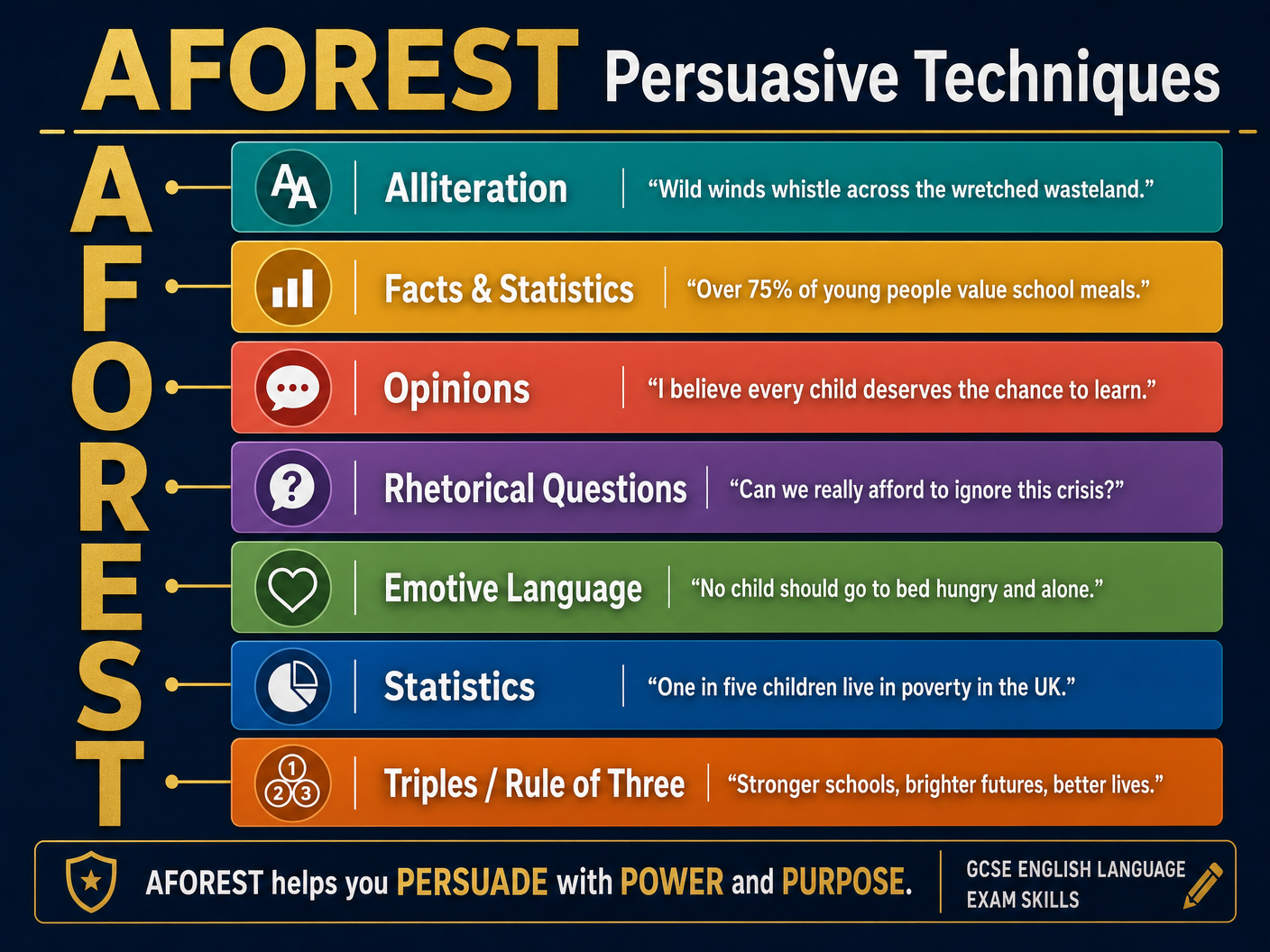
Persuasive Techniques (AFOREST)
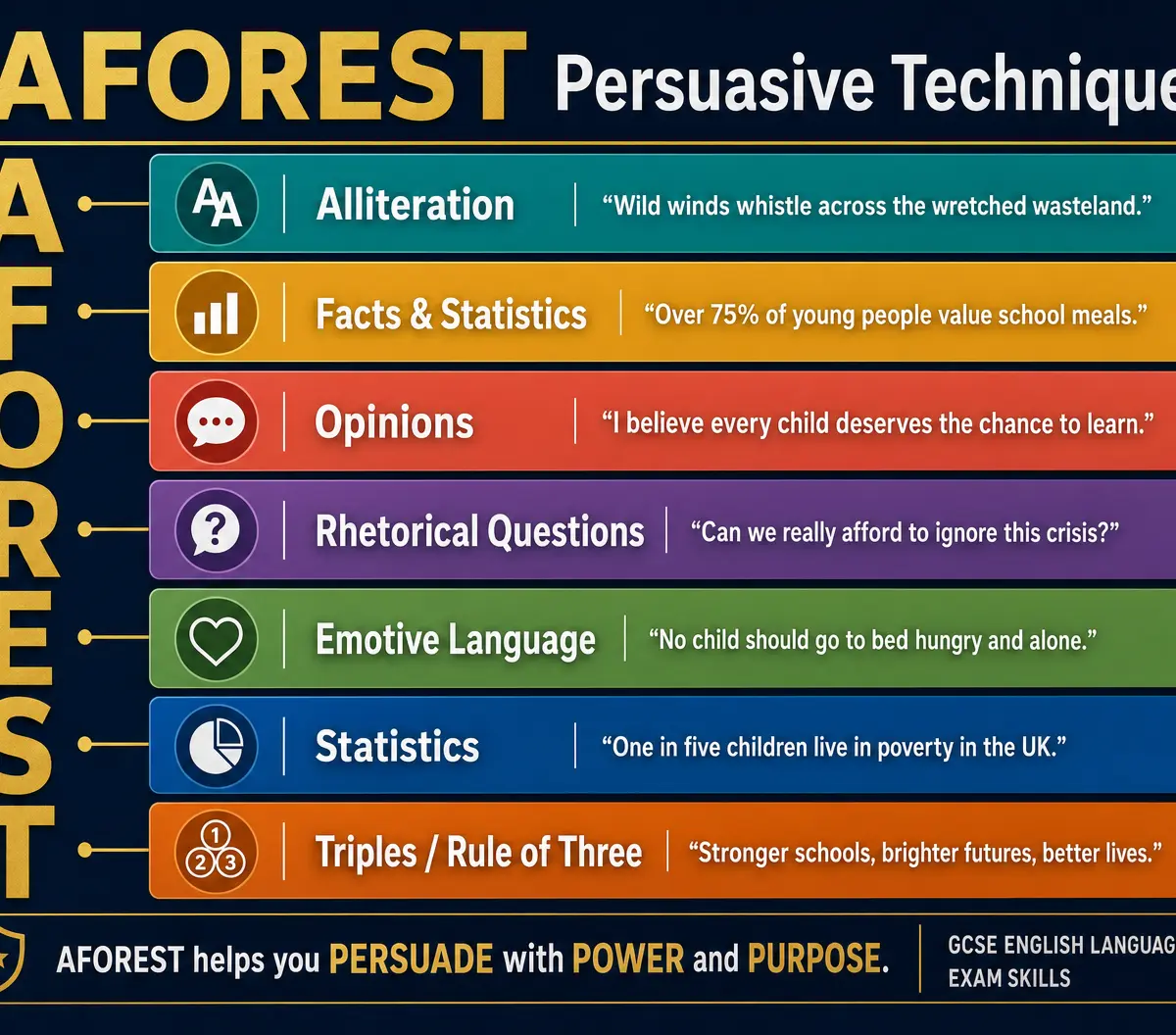
When arguing or persuading, use the AFOREST techniques to engage your reader and build a compelling case. Do not just feature-spot; ensure every technique serves your overall argument.
Technical Accuracy (AO6)
Technical accuracy is worth 16 marks. To achieve Level 4, your punctuation and grammar must be used with control and be virtually faultless.
- Vocabulary: Choose precise, ambitious words. Avoid repeating basic verbs like "said" or "went".
- Sentence Variety: Deliberately mix short, punchy sentences (for tension or impact) with longer, complex sentences (for description or detailed argument).
- Punctuation: Demonstrate control of a wide range of punctuation, including semicolons (;), colons (:), dashes (—), and parenthetical commas.
- Paragraphing: Use paragraphs clearly to organise your ideas. Use discourse markers (e.g., "Furthermore", "Conversely", "Consequently") to link paragraphs cohesively.
Visual Resources
3 diagrams and illustrations
Interactive Diagrams
2 interactive diagrams to visualise key concepts
Conceptual Flow Outline
Exam approach flowchart for Section A and Section B
Conceptual Flow Outline
Comparison of Component 1 and Component 2 writing tasks
Worked Examples
2 worked examples — open one to explore the question and available guidance.
Practice Questions
Test your understanding — click to reveal model answers
Write a description of a busy market. (20 marks)
Hint: Focus on what you can see, hear, and smell. Don't write a story with characters and dialogue.
Write an article for a teenage magazine with the title: 'Why we need to disconnect from our screens'. (20 marks)
Hint: Remember the PAF: Purpose (persuade/inform), Audience (teenagers), Form (magazine article). Use a catchy headline and direct address.
Write a story that ends with the sentence: 'It was a mistake I would never repeat.' (40 marks)
Hint: Plan your narrative arc backwards from the final sentence. Ensure the ending feels earned, not tacked on.
Write a speech to your local council arguing for more funding for youth facilities in your area. (20 marks)
Hint: Use direct address ('Councillors', 'You'). Employ the AFOREST techniques, especially emotive language and facts.
Write a personal recount of a time you faced a significant challenge. (40 marks)
Hint: A recount must be grounded in reality but still use creative writing techniques (sensory detail, varied sentences, pacing).